
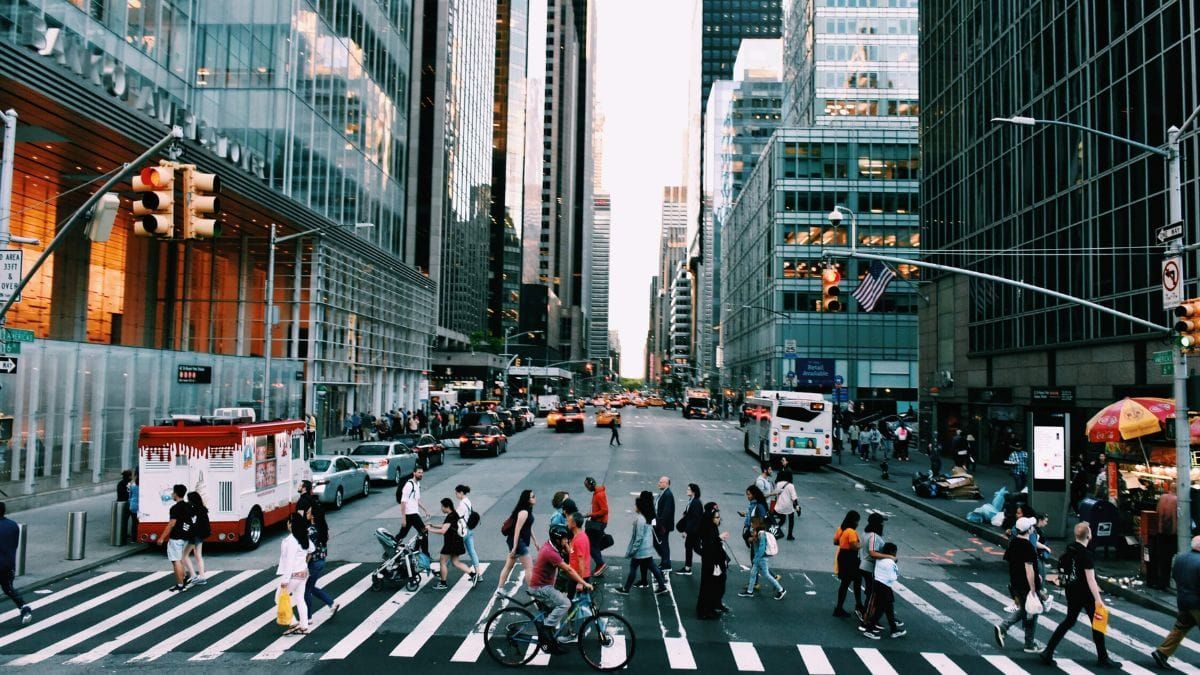
Sometimes I think about two people meeting at a red light at eight in the morning. One is a construction worker wearing a helmet and work clothes. The other is a doctor driving a better car, probably living in a better neighborhood, perhaps already thinking about another holiday abroad. Socially, we understand immediately who has succeeded. One is working class. The other is upper-middle class, perhaps even wealthy by ordinary standards.
Their lives are obviously different. The doctor has more security, more comfort, more room for error, and access to things the construction worker may never afford. These differences are real and consequential.
But at eight in the morning, they are also doing something remarkably similar.
They are both going to work because their lives still require them to go.
This distinction has been sitting in my head lately because I have been looking at inequality data, and the strangest thing about these charts is not simply how unequal the world has become. It is what happens to the categories we normally use when the scale becomes large enough.
We talk constantly about the poor, the working class, the lower-middle class, the middle class, the upper-middle class, high earners, professionals, and the rich as if these were reasonably spaced positions on one economic ladder. From close enough, they are. A person earning $30,000 and someone earning $200,000 obviously do not experience the same life.
But zoom out far enough and some of those enormous social differences begin to look surprisingly small.
The World Inequality Report 2026 estimates that the global top 0.1% receive about as much income as the entire bottom half of humanity. Even more strikingly, roughly 5,600 adults at the extreme top collectively own more wealth than 2.8 billion adults in the bottom half of the world.
That is the visual shock I find interesting. Once these groups are placed on the same scale, much of what we call the middle begins to compress.
The comfortable professional may feel economically separated from someone earning half as much, and in everyday life that separation can be very real. But compared with a level of wealth where ownership itself produces extraordinary income, both appear much closer to one another than either may imagine.
This does not mean the middle class is fictional. It exists as a meaningful difference in comfort, stability, consumption, education, housing, and exposure to risk. What begins to look questionable is treating these categories as if they described fundamentally different relationships with the economy.
A doctor with a large mortgage, two cars, insurance, children, property costs, subscriptions, holidays, and a professional lifestyle may earn many times more than another worker while remaining entirely dependent on the next salary arriving. Remove the salary for long enough and the structure begins to crack.
A personal balance sheet does not care very much about status. Housing, food, insurance, transportation, debt, services, and all the recurring costs of maintaining a particular life simply keep returning. If those obligations require continued labor income, then work remains compulsory, even when the work is prestigious and the breakfast plate is nicer.
This is where Nietzsche's distinction becomes useful. In Human, All Too Human, he wrote that anyone who does not have two-thirds of the day for himself is effectively a slave, regardless of whether he is a statesman, merchant, official, or scholar. The broader aphorism is aimed precisely at the strange prestige of constant activity: a person may be extremely busy while performing very little activity that is truly his own.
The point is not that socially useful work is somehow degrading. A doctor performs essential work. A construction worker creates something tangible. The question is ownership of time.
Seen through that lens, blue collar and white collar become less metaphysically different than we usually imagine. Both people put on the appropriate uniform, travel to the appropriate institution, fulfill a contract, receive income, and use that income to preserve the structure of life around them.
One may do it with considerably more comfort.
But neither necessarily owns his day.
This is partly why late capitalism increasingly reminds me of joining a game of Monopoly after most of the board has already been purchased and covered with houses and hotels.
Perhaps you get a better salary than another player. Maybe you effectively receive two dice while someone else gets one. You move around the board faster, collect more money when you pass Go, and understandably begin to feel that you are doing quite well.
Compared with the person behind you, you are.
The problem is that you still do not own the board.
Most of the money you collect encounters obligations somewhere along the next lap: housing, interest, insurance, services, consumption, or access to assets controlled by someone else. Meanwhile, ownership operates under a different logic. Rent, dividends, interest, equity, and asset appreciation are not constrained in the same way by the hours available inside one human body.
Capital can compound while a person sleeps.
Labor cannot work more than twenty-four hours a day.
At some point, this becomes mathematically difficult to outrun. And yet most people do not organize their social identity around this distinction. They compare themselves primarily with the person standing on the neighboring square.
This brought me to B. R. Ambedkar and his concept of graded inequality. He was writing about caste, which is obviously not equivalent to contemporary economic class and should not be flattened into one. But the psychological mechanism he described is remarkably useful.
Ambedkar described graded inequality as a hierarchy in which each group looks upward with deference and downward with contempt. The structure does not simply produce a top and a bottom. It gives each layer a position relative to another layer, making solidarity difficult because almost everyone has someone above to admire and someone below from whom to distinguish themselves.
That is a remarkably stable design.
A simple division between a tiny owning class and everybody else would be psychologically obvious. A graded hierarchy is much more effective because everyone receives a smaller territory of status.
The doctor does not see himself in the construction worker. The homeowner does not see himself in the renter. Someone who can still absorb rising food prices may hear another person complaining about the price of eggs and quietly think that this is a problem for people who failed to organize their lives properly.
The eggs are becoming more expensive for him too.
He can simply absorb the increase for longer.
And because he can absorb it for longer, the pressure becomes evidence of status rather than evidence of a shared vulnerability.
This is where graded inequality becomes more than an economic curiosity. It becomes a mechanism for preventing class consciousness.
People who own very large amounts of capital do not need a secret initiation ceremony to understand their common interests. Their position makes many of those interests obvious. They benefit when ownership remains protected, assets appreciate, taxes on capital remain favorable, and the institutions supporting those assets remain stable.
This is also why elaborate theories about secret elites have always felt slightly disappointing to me. Given the scale of inequality, reality indeed looks absurd enough to invite secret societies, hidden plans, global control rooms, and whatever conspiracy happens to be circulating through Instagram that week.
But the boring explanation may be more disturbing. No grand conspiracy is necessary. Wealthy people often move through similar institutions, inhabit similar networks, and understand which arrangements benefit them. Their position already coordinates much of their behavior.
If you own the Monopoly board, there is not much mystery about what you want from the next round. You want the game to continue.
The stranger part is what happens to everybody else. People whose lives remain dependent on continued work rarely understand themselves primarily through that shared dependency. Instead, they divide into an elaborate collection of identities: poor, working class, lower-middle class, middle class, upper-middle class, professional, educated, successful, comfortable.
Capital develops something resembling class consciousness almost automatically.
Labor develops lifestyle categories.
This asymmetry is extraordinary because the second group is vastly larger. In democratic societies, people dependent on labor possess enormous electoral power simply through their numbers. If they understood their economic interests in sufficiently similar terms, they could demand very different arrangements around taxation, bargaining power, public services, housing, ownership, and the distribution of economic gains.
But they rarely experience themselves as one group.
The hierarchy fragments the common interest before it becomes consciousness.
A person who finally reaches a comfortable professional life may even become more invested in the structure rather than less. After years of education, work, risk, discipline, and delayed gratification, the new position means something. The house matters. The title matters. The safer neighborhood matters. The fact that one no longer needs to inspect every price in the supermarket matters.
None of that is fake.
And precisely because it is real, it becomes something worth defending.
This is where the structure becomes psychologically brilliant. You do not need to give people nothing and force them to accept misery. You give them something fragile: a profession, a mortgage, a retirement account, a better car, a small amount of savings, a slightly safer position than the person below.
Then the fear of losing that position begins doing much of the work.
A person may even become emotionally invested in protecting “the rich” because the language of success overlaps with the identity he spent decades constructing. A tax aimed at concentrations of wealth can feel psychologically like an attack on his own achievement, even when his net worth would barely register on the same chart as the fortunes actually being discussed.
It is a little like two people encountering a bear deep in a forest. One starts preparing to run, while the other points out that neither of them can possibly outrun it and suggests they should work together. “You might be right. But I don't have to outrun the bear,” he replies. “I only have to outrun you.”
Much of class behavior begins to make sense through the same logic. People focus on securing a better position in a race that effectively traps them for life rather than asking why they are so deep in the forest in the first place.
The remarkable part is that people who could possess enormous collective power instead spend so much energy policing one another's tiny differences in status.
We rank one another. We judge who deserves help. We distinguish the responsible from the irresponsible, the educated from the uneducated, the respectable worker from the lazy one, the homeowner from the renter, the person who still manages from the person who no longer can.
We protect the rung.
And perhaps that is the part inequality charts cannot show.
A chart can show that a tiny number of people collectively own more than billions of others combined. It can compress much of what we proudly call the middle class until its differences become difficult to see beside extreme wealth. But it cannot show why that enormous majority does not experience itself as an enormous majority.
The doctor still stops at the red light. The construction worker stops beside him. Each may look at the other and see an entirely different social class, and in many ways they are right. But both are still waking up because another part of their life has already been sold to the day ahead.
Somewhere far above that intersection is a form of wealth for which neither uniform matters very much. Perhaps that is the real genius of graded inequality. It does not merely build a ladder. It convinces the people climbing it that the most important question is who stands one rung above or below them, rather than who owns the ladder.
Thanks for reading. If this essay resonated, you can subscribe, support the project, or explore the reading lists I curate.