Recently, in moments of decreased clarity or even a little chaos, I’ve felt the need to revisit my beloved philosophy classics. Of course, I'm not writing about modern philosophy or academic comments about philosophy.
No, I wanted to revisit the stuff Marcus Aurelius wrote to himself in a tent with half the empire on fire. The poems Lao Tzu supposedly wrote by a stream. What Socrates said in his defence, captured by Plato. Not comments, not introductions, not explanations — but their actual words, to let them touch my mind directly and offer some quiet guidance between the lines.
It helped. Of course, it helped. It always does.
But then I snapped back into everyday reality.
I opened social media for a small, innocent doomscroll. As usual, nonsense screamed from every corner. No surprise there. But something particular hit me this time. Because I was recently reading those old philosophers, the recommendation engines started shoveling “related content” at me: quotes, reels, aesthetic edits, productivity hacks “inspired by the Stoics,” and all that.
And I found myself giggling inside. In these little digital shrines, people paint Lao Tzu, Socrates, Plato, Aristotle, or Marcus Aurelius as godlike sages who, if they lived today, would surely lead a perfectly self-regulated life far away from social media, far from technology, far from the noise. Calm, detached, minimalist, probably drinking herbal tea in an empty white room, untouched by the stupidity of the timeline.
This fantasy is especially strong in circles obsessed with “modern Stoicism,” where the philosophy becomes a performance-enhancement protocol that fits neatly into late-capitalist expectations. You know the drill:
- Wake up at 5:00 AM
- Take cold showers
- No social media
- No gossip
- Avoid distractions
- Practice quiet discipline
- Be productive, calm, always rational
A full program for turning humans into ultra-efficient, low-maintenance machines. A spiritual firmware update — installing “Focus Mode” and deleting whatever doesn’t serve output.
And it gets funny when you remember that, for the Stoics, the ideal figure was Socrates. Sometimes Marcus Aurelius, sure, but even he constantly points back to Socrates as the model.
Do you see the joke already? No? Let’s keep going.
If there’s one thing I’m quite sure of, it’s this: Socrates would not be sitting in a cabin somewhere, meditating in silence, proudly not having Instagram.
Socrates would be dreaming of YouTube, TikTok, Twitter, Twitch, Discord, Substack — all of it. The idea that billions of people are talking without a filter — from every background — ranting about their lives, arguing about everything and nothing… It would be paradise.
A natural, unfiltered representation of human consciousness, exposed in real time? Comments, replies, live chats, people thinking out loud? For Socrates, this wouldn’t be entertainment. This would be data — the largest collection of experimental human material in history.
He would love it. And he would participate.
See, through his questioning — the famous “Socratic method” — he poked at blind spots people didn’t know they had. He lived in the middle of the Athenian marketplace: noise, politics, drama, rumours, commerce. He didn’t retreat from it. He planted himself there.
Back then, he had hundreds of people to interact with. Now he’d have billions. Instead of wandering the streets of Athens, he’d be wandering timelines and comment sections, asking simple questions that open into deep confusion.
And yes, he’d be arguing with AI chatbots at three in the morning, trying to find their blind spots — not because he’d love technology, but because he’d love what it reveals about us.
He’d travel to conventions — tech conferences, philosophical gatherings, political rallies — walking around with a cheap microphone and a tiny YouTube channel, asking uncomfortable questions on camera. “Explain to me what beauty is.” “What does freedom mean for you?” Watching people in positions of power stumble over their own concepts, exactly as they did in Athens — the same pattern that eventually led to his trial and death.
He wasn’t a monk. He wasn’t an influencer doing mindful morning routines. He was a wandering philosophical provocateur — someone who could walk into any space, ask one gentle question, and quietly rearrange everyone’s certainties.
And he knew exactly what he was doing.
Socrates is the easiest to picture in the middle of our digital chaos — but he wouldn’t be the only philosopher refusing the modern fantasy of withdrawal.
Lao Tzu wouldn’t care about online arguments at all. Taoism isn’t about wrestling the noise; it’s about letting the river carry itself. But even he wouldn’t vanish. I can imagine him with a tiny minimalist corner somewhere — a blog with no design, a channel with no face. Short texts dropped like stones into water, then silence.
He wouldn’t debate. He wouldn’t preach. He’d appear rarely, say one riddle-like sentence, and disappear again. People would screenshot his lines without knowing where they came from — perfect Taoist anonymity.
And because Taoism is about flowing with whatever is, I can easily picture him resetting his mind inside an online game — wandering a digital landscape doing nothing. The modern version of sitting by a stream, letting muddy water clear once you stop stirring it.
Marcus Aurelius, on the other hand, would move in the opposite direction. He already carried an empire on his shoulders, so modern tools would feel like relief. He wouldn’t preach “digital detox.” He’d be grateful for time-tracking apps, calendars, task managers, cloud notes — anything that helps hold a life together.
A digital workspace would become his new tent-notebook: reminders, reflections, speeches, apologies, warnings not to become a tyrant. And yes, he’d use social media — not to build a brand, but to communicate in crisis. Probably awkwardly. Probably while exhausted.
Different personalities, different eras — but none of them would run from the world. They’d simply meet it in their own way.
This is what I’m trying to convey: philosophy doesn’t require an ascetic death while you’re still alive.
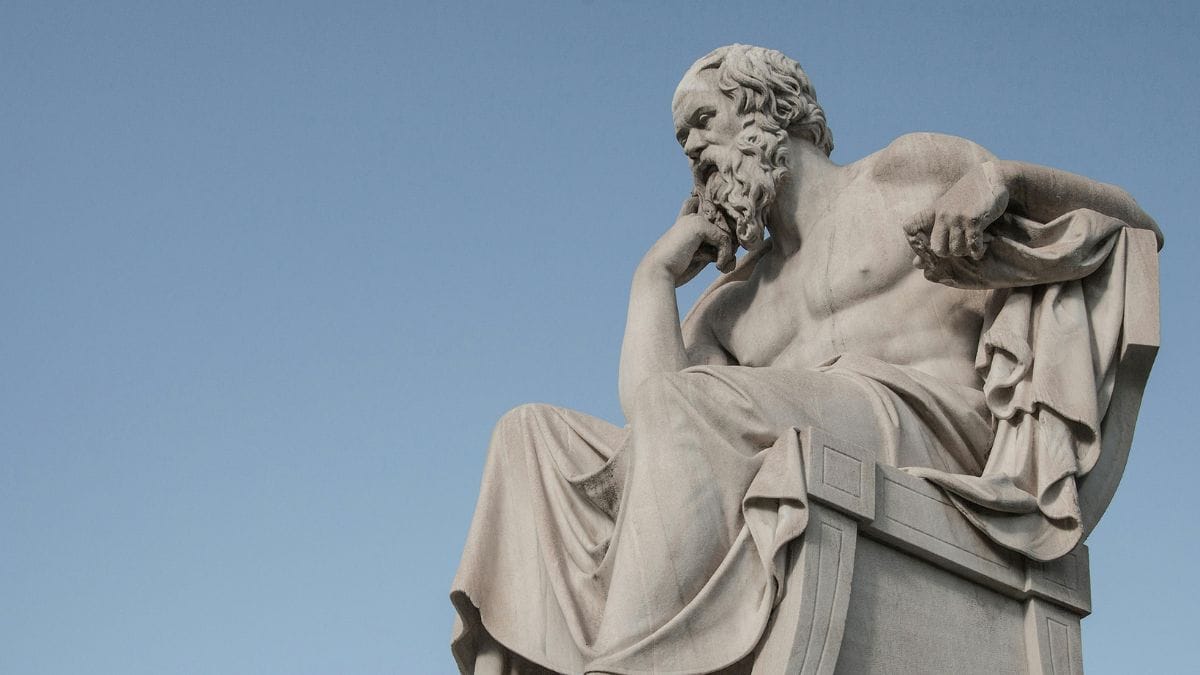
Ancient philosophers weren’t godlike statues frozen in perfect posture. They were people trying to understand themselves and the living whole. Curious, capable, wounded, confused. Just like us — only more stubborn about asking questions.
Take Plato. Strip away the marble bust, and you see a young man who watched his beloved teacher condemned to death by the state, and then spent the rest of his life trying to understand how a supposedly civilized society could destroy a person like that. Of course he critiqued political structures. What else do you do with that kind of trauma?
They were humans — just extremely capable ones. They bled, grieved, felt lost, and made mistakes. They didn’t transcend life. They entered it.
So no, I don’t think they’d hide in a cave today, proudly deleting apps and pretending the world doesn’t exist. They’d walk straight into the center of it — into the noise, the chaos, the nonsense — and use it as material. As a mirror. As a laboratory of the human mind.
Even an online game could become their modern agora — another place where human nature speaks before it thinks. A crowded Discord server, a Twitch chat, a comment section — these aren’t beneath philosophy. They are philosophy, raw and unfiltered. And maybe that’s what we keep forgetting when we turn philosophy into productivity hacks or romantic monk-routines:
Clarity doesn’t come from sterilizing life into a perfect schedule or withdrawing into an emotionally sanitized bubble. It comes from seeing life as it is, while standing right in the middle of it — eyes open, questions alive.
That’s how philosophy started — not in a quiet retreat, but in the noisy marketplace of Athens, where Socrates stood among people, not above them.
If he were here now, I doubt he’d be selling “No Social Media” as the path to wisdom. He’d probably be asking you, right there in the comments:
“So tell me… what exactly are you trying to escape?”
Thanks for reading. If you enjoy my work and want more like this, consider supporting it. This space exists thanks to readers — essays and research take time. You can subscribe, contribute, or explore reading lists I curate. Every bit of support helps.