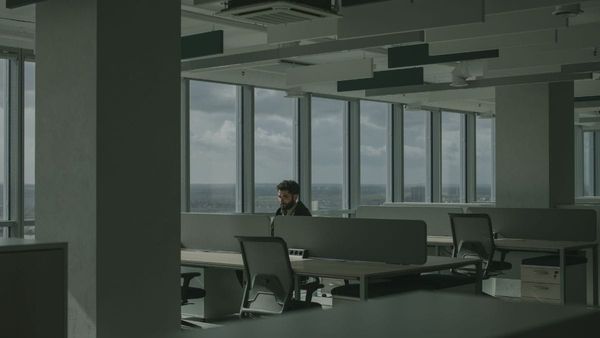
Recently, I had a simple realization: I noticed how much better my life became after I stopped listening to certain kinds of intelligent people. Yes, not some silly online drama. That would be too easy.
I mean very intelligent people. Professors, analysts, economists, geopolitical commentators, public intellectuals, people with books, titles, institutional prestige, and enough rhetorical skill to make despair sound like depth. People who can sit behind a microphone and make the whole planet sound like a system they have personally decoded.
And to be fair, there was a reason to listen.
For me, this did not begin as some abstract fascination with geopolitical lectures. It began with the atmosphere itself. First came the global pandemic, which already made the old normal feel strangely fragile. Then came the war just beyond the border of my country, Poland. Then the broader sense that the whole order many of us had taken for granted was no longer as stable as it once seemed. The geopolitical atmosphere became heavier. Institutions began speaking with less confidence. Power started showing more of its real face.
At some point, it felt almost necessary to put the spiritual and philosophical lectures aside for a while and listen to the hard power content instead.
And I was hardly alone in that. These kinds of voices became popular because the need for orientation became popular. People did not suddenly develop some strange taste for geopolitical analysis. They were trying to understand why the ground felt less solid than before.
And in the beginning, some of these voices do provide that. They help you understand who shaped the world, how certain games are played, why slogans are often just polished instruments of power, and why history did not begin yesterday. There is value in that. A person should not move through reality like a child in a museum, touching every object without understanding what kind of building they are inside.
But orientation can quietly become an occupation.
That was the part I did not notice immediately.
See, I have always been somewhat vulnerable to processing too much of the world from too many sources at once. Maybe it is curiosity. Maybe it is ADHD in action. My sister, who is a psychologist, would probably bet on the second. Either way, this tendency gave me a strange education: philosophy, spirituality, politics, economics, social media, human behavior, cultural nonsense, and the general circus of consciousness available to everyone with an internet connection.
For a while, I even felt slightly guilty about that. As if a serious person should stay above the noise, live in clean ideas, and avoid the marketplace of human nonsense altogether. But the more I read about Socrates, the less convincing that guilt became. Socrates was not a monk hiding from the city. He lived in the marketplace. He went where people were, questioned their certainties, and exposed the beautiful little lies they mistook for knowledge. So perhaps the problem was never the marketplace itself.
The problem is what kind of relationship one has with it.
Socrates entered the marketplace to loosen illusion, not to build a career out of keeping people attached to it. His wisdom was almost negative: he knew that he did not know, and tried to show others that much of their certainty was just decorated ignorance. The movement was toward release, toward leaving the cave, toward breaking the spell of inherited concepts.
Much of today’s expert culture works in the opposite direction.
Not always intentionally. Not always cynically. But structurally.
For many professors, analysts, commentators, and public intellectuals, this is not just contemplation. It is a way of life. Their posts on X, their interviews, their Substack essays, their podcasts, their books, their speaking circuits, their appearances on friendly independent media — all of this forms an ecosystem. The more you watch, the more they matter. The more anxious you become, the more necessary they appear. The more you feel that history is moving too fast to understand without them, the more likely you are to click again, subscribe, share, buy the book, or sit frozen in the chair while another serious person explains the newest movement of shadows on the wall.
That does not make them evil. But it does make the relationship less innocent.
Because there is a difference between wisdom and psyche colonization.
Wisdom, at least in its cleaner forms, releases you. You encounter an insight, you struggle with it, you absorb what is real in it, and then something in you becomes quieter. Not necessarily happier, not more positive, not spiritually perfumed — just clearer. A real philosophical or spiritual insight does not need to keep you trapped inside the source forever. It gives you something and lets you go. It points beyond itself.
That is why reading ancient philosophy directly, or listening to a genuine spiritual teacher, can feel so different from consuming endless modern commentary. At its best, wisdom is not trying to occupy your inner life. It is trying to free it.
Modern expert discourse often does something else. And this is precisely what makes the serious version more dangerous: it can come from people worth listening to, while still being mad in a very respectable way.
Because once you enter that world too deeply, you begin to notice its atmosphere. It is not simply knowledge. It is agitation wearing a suit. Trump wrote this. Putin responded that. Araghchi posted something. Someone reposted it. Some ambassador gave an interview. Some statement means this. Some silence means that. Some sentence reveals the hidden architecture of history. A new escalation. A new prediction. A new interpretive emergency.
And yes, it can be impressive. There is a certain intellectual athleticism in being able to store all this symbolic debris and recite it with confidence. But at some point, one has to ask a very simple question:
Is this wisdom, or is this just advanced imprisonment?
Plato’s cave keeps coming back here. The prisoners stare at shadows on the wall and compare shapes. Who recognizes them better? Who predicts the next movement? Who understands the pattern? Perhaps they even develop hierarchies inside the cave. The most respected prisoner is the one who can analyze shadows with the greatest sophistication.
But he is still facing the wall.
That, increasingly, is how much of modern commentary feels. Not always, not entirely, but often enough to matter. A group of highly intelligent people sitting inside the symbolic cave, discussing the movement of shadows with enormous seriousness. Who said what. Who responded. What it means. What it reveals. What will happen next. And because the language is serious, because the titles are real, because the references are historical, because the tone carries authority, we mistake this for contact with reality itself.
But symbols are not reality. Commentary is not life. Interpretation is not wisdom.
This is not an argument for ignorance. Serious voices can be useful; they can help us understand power, history, and the games being played around us. But there is a difference between orientation and possession.
Orientation means: I understand enough to know where I am.
Possession means: the world now lives inside me as noise.
And many people do not see the difference. They think seriousness means permanent saturation. They think that if they are anxious enough, informed enough, geopolitically stimulated enough, then they are somehow closer to truth. They confuse being updated with being awake. But very often they are not awake. They are simply colonized by other people’s nervous systems.
This is where the detox matters.
Not because the world suddenly becomes beautiful when you stop listening. It does not. Power remains real, empire lies, media feeds on panic, and institutions still speak in moral language while protecting material interests. But the inner atmosphere changes.
A person begins to realize that he does not need to let every serious voice install a worldview inside his head. He does not need the face, the tone, the tension, the daily emergency, the interpretive frame, the subtle emotional command: pay attention, this is important, stay with us, only fools look away. For basic orientation, a short dry brief is often enough. A few bullet points. A summary. A map without the emotional infection.
Because that is the part people underestimate. Content is not just information. It carries atmosphere. A person does not only tell you what he thinks. He transmits the state from which he thinks. His urgency enters you. His disgust enters you. His fear enters you. His obsession enters you. His model of reality starts speaking in your own interior voice.
And then you wonder why your mind is full of arguments you never chose.
That is psyche colonization.
It is not learning. It is occupation.
At some point, the gesture should be very simple: put your hands together, say a little Namaste, and move on. Not as contempt. More as a clean ending to an exchange that has fulfilled its proper function. Thank you for the orientation. Thank you for the map. Thank you for the warning. But I do not need to live inside your cave.
Because there is also something quietly corrupting about this arrangement. Once commentary becomes a career, it begins to obey career incentives. The commentator may still be intelligent, sincere, and useful, but he is also selling attention, relevance, books, appearances, symbolic authority, and the feeling that he is one of the adults in the room. The audience often receives something else: anxiety disguised as seriousness, someone else’s hierarchy of importance, someone else’s interior weather.
That exchange can be useful in small doses. But as a habitat, it becomes deforming. And the answer becomes clearer through subtraction. The less one exposes oneself to these voices, the more one’s own voice can return. The less one consumes other people’s grand explanations, the more the texture of actual life becomes available again. The body returns. Attention returns. Humor returns. Silence returns. The world becomes less like a battlefield of interpretations and more like a place where one can still walk, write, move, cook, dance, notice, love, and think without being permanently occupied.
This, to me, is the real distinction.
Wisdom deepens contact with life.
Psyche colonization replaces life with commentary about life.
And once that distinction becomes visible, it becomes harder to ignore. One begins to recognize when a piece of content is helping clarify reality, and when it is merely installing a foreign climate inside the nervous system. The question is no longer only, “Is this person smart?” but also, “What happens after listening to them?” Does the mind become clearer, freer, more grounded? Or does it become tense, fragmented, argumentative, and spiritually crowded?
That question matters more than we admit. Because the task is not to become uninformed. The task is to remain unpossessed.
To know enough about the world without giving the world unlimited rights over your inner life. To understand the shadows without becoming a professional shadow-watcher. To respect intelligence without confusing it with wisdom. To listen, take what is useful, and then leave before someone else’s model of reality becomes your home.
Thanks for reading. If you enjoy my work and want more like this, consider supporting it. This space exists thanks to readers — essays and research take time. You can subscribe, contribute, or explore reading lists I curate. Every bit of support helps.